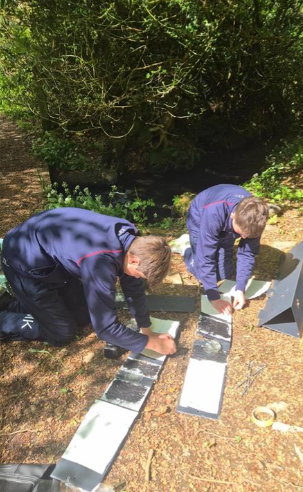
Pupils preparing for the Royal Society Summer Exhibition this July have been busy setting up animal track pads to investigate the presence of small mammals on site. These simple but effective devices work by enticing animals into an open-ended tunnel with food. To reach the bait, animals must first cross an ‘ink’ pad made from graphite powder and vegetable oil. As they leave the tunnel, they seemingly tap dance all over the liner paper, leaving tiny paw and tail prints behind. Analysis of paw print size and shape so far points to an abundance of bank voles down by the river.
The team also took to the stream, donning waders to collect water samples for environmental DNA (eDNA) analysis. These samples will be sent off for testing to detect traces of species that may be present but otherwise difficult to observe directly. Working with great care, pupils followed a strict protocol to minimise contamination. This included steps to avoid introducing their own DNA into the samples, as well as preventing older DNA disturbed from the stream bed from affecting the results. The young scientists are hoping to confirm the presence of water voles and the great crested newt.
On Tuesday 2 and Wednesday 3 July, our pupils will be among only 11 other schools exhibiting at the Royal Society Summer Exhibition in the Young Researcher Zone | Royal Society. This exhibition sees over 10000 visitors in one week, who come and see the work of schools like ours, alongside the 13 most innovative research projects currently being undertaken by professional scientific institutions around the UK. This is a remarkable opportunity for our pupils to share their work on a national stage and to represent Mount Kelly among the UK’s most exciting scientific research.
Article written by Mrs Russo.